
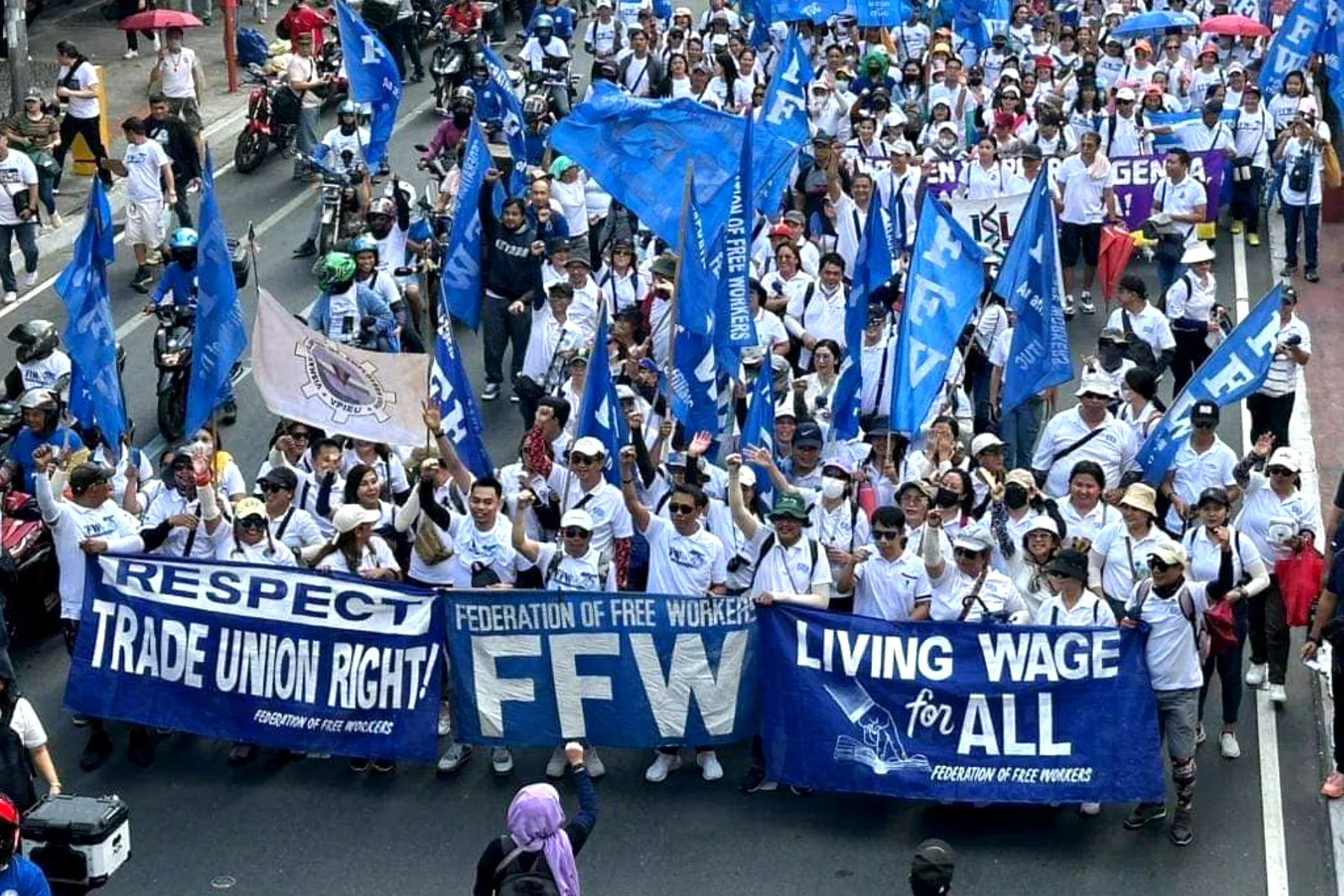
About FFW
Founded in 1950 by Bro. Juan C. Tan and Fr. Walter Hogan, SJ, the Federation of Free Workers is one of the oldest and largest labor federations in the Philippines. It has clear Christian Social Democratic orientation.
A National Trade Union Center of movement composed of traditional social trade unions, workers’ associations, workers’ cooperatives and worker-owned-and-run enterprises, community. based organizations, neighborhood associations, associations of workers in the informal economy such as market vendors, tricycle drivers and operators, jeepney drivers, migrant workers, across industry, agriculture and services.
- A membership base of 200,000 workers in the formal and informal economy in 27 provinces in 9 regions. In the formal sector, subscribed members number to 70,000 individuals, 40,000 of which are dues paying spread over 200 companies. Organizational membership is subdivided into 10 in-dustrial and sectoral groupings. Its education arm, the Philippine Social Institute (PSI), is engaged in workers education and training for its members.
- Affiliated with the International Trade Union Confederation (ITUC), ITUCAsia-Pacific, ASEAN Trade Union Council (ATUC), Building and Wood Workers International (BWI), Education International (El) and IndustriALL Global Union.
- Member of the National Tripartite Industrial Peace Council and its regional TIPCs. Some of its leaders are appointed labor sector representatives the tripartite and multipartite bodies in National Anti-Poverty Commission (NAPC), Regional Tripartite Wage and Productivity Boards (RTWPBs), Regional Development Councils (RDCs) and Technical Education and Skills Development Authority (TESDA).
- Social Dialogue partners of, and networked with, some 120 international and local governmental organizations and civil society groups of various advocacies including with the academic communities, employers’ organizations, trade unions, workers’ associations, farmers associations, non-governmental organizations, private social development agencies and political for-mations.
- Co-convenors of coalitions / alliances such as NAGKAISA! Labor Coalition, Council of Global Unions-Pilipinas and Women Workers United.
- Strategic partnership on capacity-building programs and advocacy with Danish Trade Union Development Agency (DTDA), ILO-Manila and American Solidarity Center.
Vision
FFW envisions a free, independent and responsible organization of workers, strong, stable and determined in defending workers’ rights promoting their interest. It is committed to build a truly humane society characterized by:
- Prosperous and democratic economy;
- Equality and equity;
- Active participation of all sectors in the governance of society;
- Culture of freedom, peace, justice and solidarity; and Empowered workers
Mission
FFW endeavors to unite and empower all workers into a trade union social movement to realize Decent Work.
Goals
To pursue its vision and mission, FFW aims to:
- Vigorously pursue organizing initiatives of workers in all sectors and industries;
- Develop workers’ consciousness, capacity, accountability and responsibility to defend their rights and advance their interests; Improve workers’ socio-economic well-being through work, family living wage and income security; participation in economic decisions; and, cooperatives entrepreneurial undertakings;
- Advocate and lobby for legislation that will promote and safeguard economic security and social welfare of workers;
- Strengthen alliances and solidarity with peoples in general and workers in particular;
- Promote effective participation of workers in political processes; and
- Pursue fair distribution and utilization of fruits of production.
Services
A member can avail of the following services:
Education and Capability Building. These includes seminars that raise the awareness of members on labor issues, political and socio-economic concerns. It also covers leadership, dispute settlement, the basics of collective bargaining, skills training for employment, among others.
Legal Assistance. With a battery of labor relations experts from the FFW Legal Center and Operations Department, members could avail of free legal advice and assistance for problems arising out of their union-related activities and pro-active work in the social movement.
Formulation of collective bargaining proposal. Members benefit from the rich experience of FFW Labor Relations Officers, National and Trade Federation officers and staff in the formulation of collective bargaining proposals.
Development of social dialogue skills. Members get trained on negotiating for higher wages and better working conditions at the workplace. They also get opportunities to participate in social dialogue at higher levels like at the industry level with employers’ groups, at the national level with government, and even at the international level with the ILO, international financial institutions, trade agreements, etc.
Research. Policy papers, research outputs and reference materials developed by the FFW can be utilized and maximized by members for their own use at the plant or community level.
Information and advocacy. FFW exerts efforts to make its members and the general public well-informed. Thus, regular publications, occasional papers and news releases are available to them. These are enhanced by regular focus discussions, symposiums and internet-based tools like its websites, email and social networking sites.
Organizational development. Local, affiliate and sectoral organization members are being equipped to manage and
administer their own affairs. Planning tools and activities to consolidate the organization are part of the FFW program.
Networking and linkaging. Members can benefit from the wide trade union, civil society, government and international network the FFW has developed through the years. These are crucial in formulating collective bargaining proposals, settling disputes, doing research, advocacy and fostering partnerships for joint activities promoting shared goals.
Socio-economic ventures. Entrepreneurial activities encouraged by the FFW to augment its members’ income.
Members can get assistance in the establishment of cooperatives or workers’ enterprises. The FFW can facilitate credit access from government and social partners.
International Relations. Members can express solidarity at the global level with FFW’s regional partners at the ITUC and Global Union Federations (GUFs). FFW has consultative status with the International Labor Organization (ILO).