
FFW Welcomes Pope Leo’s Magnifica Humanitas, Urges Gig Workers to Build Unions, Not Just User Ratings
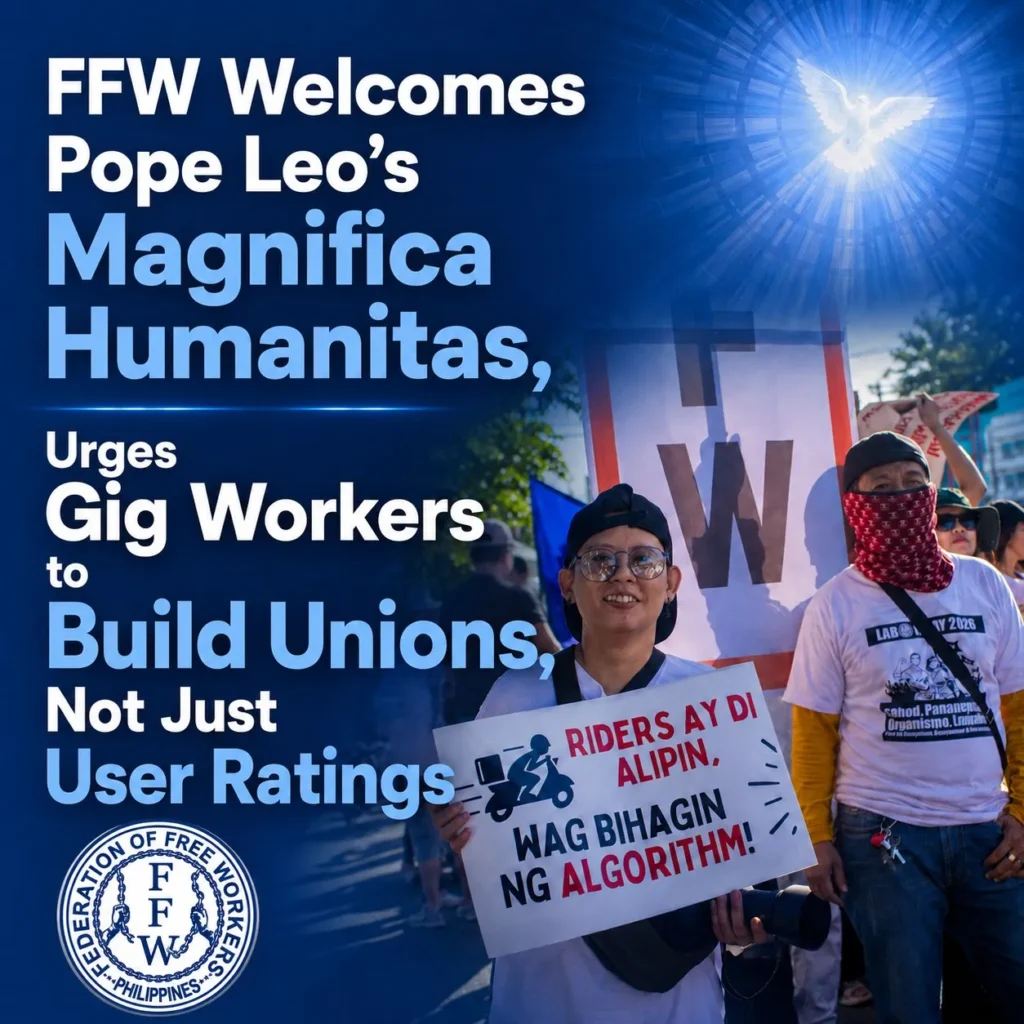
This Pentecost Sunday, the Federation of Free Workers (FFW) warmly welcomes the new encyclical of Pope Leo XIV, Magnifica Humanitas, which calls for the use of Artificial Intelligence and modern technology for the common good and the protection of human dignity.
Magnifica Humanitas will be published on May 25, 2026.
Signed on May 15, 2026, the encyclical fittingly marks the 135th anniversary of Rerum Novarum, the historic social encyclical of Pope Leo XIII that defended the dignity of labor, the rights of workers, the right to organize, and the moral duty of society toward social justice.
“From factory machines during the Industrial Revolution to today’s ‘thinking machines,’ the Church reminds the world of one timeless principle: technology must serve the human person — not reduce the human person into a tool or disposable data”, FFW Board Member and Ateneo de Davao Grade School Faculty Union President Arlene Golloso-Degayo said.
Though it is a secular and pluralistic national labor federation, the FFW is among the three historic organizations in the Philippines inspired by the social teachings of Rerum Novarum. Founded in 1950 through the vision of Juan C. Tan and Fr. Walter Hogan, SJ, the FFW has long advocated for decent work, living wages, security of tenure, freedom of association–the right of workers to organize unions; and the dignity of labor.
“The challenge of our time is no longer only about machines replacing muscle, but algorithms replacing judgment, security, and even humanity. AI must never become an excuse for exploitation, contractual insecurity, union busting, or treating workers as mere commodities and extensions of an app,” added Ma. Victoria Bellosillo, FFW Women’s Network (FWN) President and Union President of the Baptist Central Philippines University in Iloilo City.
The FFW noted that gig and platform workers are at the frontlines of the digital economy, yet many remain without job security, social protection, living wages, or effective collective bargaining.
“Apps may run on algorithms, but society still runs on workers,” Atty. Sonny Matula, FFW President, said.
The FFW called on gig workers to organize into unions, associations, and workers’ collectives, stressing that in the digital age, isolated workers can be muted by an app—but organized workers can be heard. Early this year, the FFW established DigitALL Workers Pilipinas, to help achieve this objective.
A study of the International Monetary Fund at the end of 2024 warned that AI could affect as much as four out of every ten workers in the Philippines. This could lead to the displacement of millions of workers, the FFW said.
The FFW stressed that innovation and productivity are welcome, but they must walk hand-in-hand with human rights, social justice, living wages, and workers’ participation in shaping the future of work.
“The Holy Father’s message is clear: workers, the poor, and those in the peripheries of society must not be left behind by technological progress. They must be brought to the center of economic and political decision-making,” Atty. Matula quipped as he heard the Pope said in a meeting with leaders of the world popular movement in the Vatican late last year.
“As Rerum Novarum confronted the excesses of the first industrial age, Magnifica Humanitas speaks to the digital age, platform workers, gig and delivery riders, among others. The message remains beautifully stubborn: the human person comes first,” Atty. Matula said.